
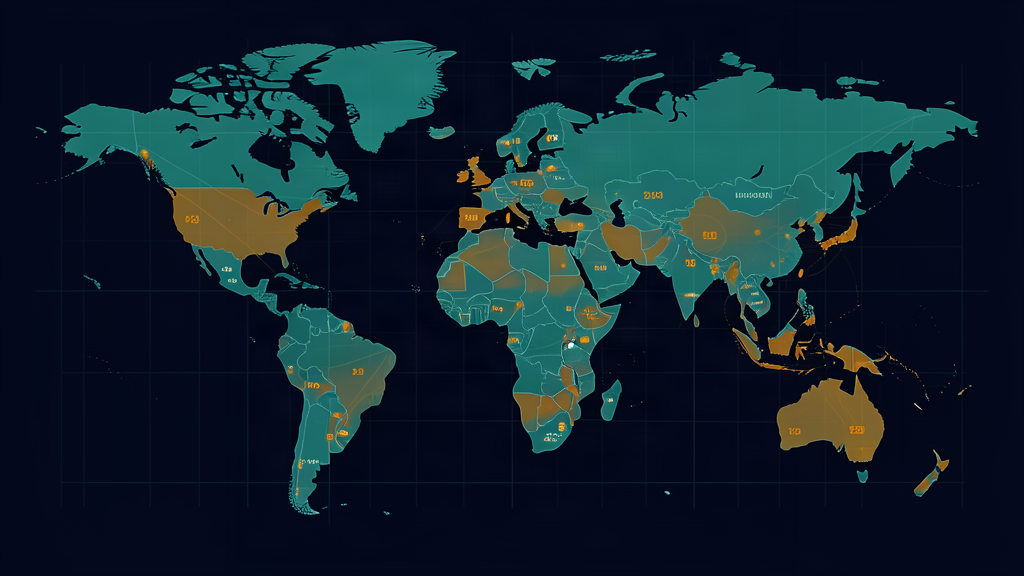
Title: Quantifying the Regulatory Landscape: How Mirror AI Scores and Compares Crypto Regulation Across Jurisdictions
Reading time: 8 min Audience: Both Capability spotlighted: Mirror AI Compliance Intelligence — jurisdiction scoring, cross-border regulatory comparison, obligation extraction with citation network, and structured document corpus
Introduction
You're a compliance officer at a crypto exchange expanding into a new market. Your CEO asks: "How hard is it to operate in the UAE versus the EU?"
You could read 47 regulator websites, 12 consultation papers, and 6 legislative frameworks. You'd still struggle to answer quantitatively — "the UAE is about 80% as regulated as Australia for AML purposes" — because the data doesn't come with scores attached.
This is the problem Mirror AI's compliance intelligence stack was built to solve: taking regulatory text — unstructured, jurisdiction-specific, updated on different schedules — and turning it into structured, comparable data.
This week, four PRs shipped that make that comparison significantly more powerful:
- PR #221 (
mirror_api_data) — Materialized regulation data v5, unifying document keys across 28,542+ obligation extractions - PR #225 (
mirror_api_data) — Authority status weighting, adding relative importance scores to regulatory bodies - PR #267 (
mirror_app) — Compliance dashboard rebase with a citation network spanning 2,890 links, so every extracted obligation points back to its source document - PR #278 (
mirror_app) — Authority status UI, bringing that weighting into the dashboard
Together, these changes mean you can now compare regulatory environments not just by reading documents, but by their numbers.
How It Works
The Problem: Regulation Is Not Quantitative by Default
Regulatory text is written in natural language — paragraphs, clauses, sub-sections. A document from ASIC (Australia) and a regulation from the SEC (US) may cover the same topic (AML/CTF) but use different terminology, different structures, and different levels of detail.
Comparing "how regulated" a jurisdiction is means solving three problems:
- Extraction — Turn paragraphs into discrete obligations ("must conduct a risk assessment")
- Normalisation — Map those obligations to consistent topics (AML, licensing, data protection) so they're comparable
- Scoring — Measure each jurisdiction's coverage, stringency, and clarity per topic
What Changed This Week
PR #221 — Regulation Materialize 5b is the fifth iteration of Mirror AI's obligation extraction pipeline. Each iteration improves the detection model, adds more documents, and refines how obligations are structured. The 826,000-line change reflects both new extraction runs and data quality improvements across the corpus.
PR #225 — Authority Status Weighting introduces a critical new dimension: not all regulatory authorities carry the same weight. A guidance note from a central bank has more regulatory force than a consultation paper from an advisory body. The weighting system assigns relative importance scores to each authority, so jurisdiction scores reflect who is regulating, not just how many documents exist.
PR #267 — Compliance Dashboard + Citation Network brings this data into an interactive interface. Every extracted obligation now has a citation trail — you can click from "must conduct a risk assessment" directly to the source document clause it came from. This turns the compliance database from a black box ("the AI says so") into an auditable reference system ("the AI says so, and here's section 6.1 of the AML/CTF rules").
PR #278 — Authority Status UI ships a visual interface for exploring what each regulatory authority is doing — whether they're active, what topics they cover, and how their weight compares to other authorities in the same jurisdiction.
What the Scores Mean
Mirror AI computes three component scores per jurisdiction and topic, blended into an overall score (0-100):
| Score | What It Measures |
|---|---|
| Coverage | How many aspects of the topic are addressed — the breadth of regulation |
| Stringency | How demanding the rules are — strictness of requirements |
| Clarity | How unambiguous the language is — well-defined vs aspirational |
| Overall | Weighted blend of all three |
| Doc Count | Number of source documents analysed — the sample size behind the score |
Real-World Example: Comparing AML/CTF Regulation Across Jurisdictions
Let's walk through a concrete comparison using Mirror AI's compliance tools, queried on September 24, 2026.
The Question
"Which jurisdictions have the strongest AML/CTF frameworks for crypto, and how do they compare?"
Step 1: Pull Jurisdiction Scores
get_regulation_jurisdiction_scores(topic="aml-ctf", limit=10)
Results — AML/CTF scores by jurisdiction:
| Jurisdiction | Documents | Coverage | Stringency | Clarity | Overall |
|---|---|---|---|---|---|
| US | 20 | 100.00 | 100.00 | 100.00 | 100.00 |
| AU | 59 | 100.00 | 100.00 | 88.14 | 96.05 |
| AE | 4 | 60.00 | 81.25 | 100.00 | 80.42 |
| EU | 4 | 60.00 | 100.00 | 70.00 | 76.67 |
| GLOBAL | 2 | 30.00 | 100.00 | 100.00 | 76.67 |
| FR | 1 | 15.00 | 100.00 | 68.00 | 61.00 |
| HK | 1 | 15.00 | 100.00 | 64.00 | 59.67 |
What the Numbers Tell Us
Australia leads in document depth — 59 source documents analysed for AML/CTF alone. That's nearly 3x the US count. But the US scores the same on coverage and stringency from fewer documents, suggesting a more consolidated regulatory framework.
Coverage drops outside AU and US — the UAE and EU each have only 4 AML/CTF documents in the corpus, scoring 60% on coverage. This doesn't mean those jurisdictions lack regulation entirely — it means the corpus has less data for them, and the scores reflect that honestly.
Clarity is the differentiator — Australia scores 88.14 clarity vs the US's 100.00. Both have comprehensive frameworks, but the US's regulatory language is scored as more clearly defined. This is directional guidance (the corpus has a known PDF extraction gap), but the relative ranking is useful.
The authority weighting changes the picture — with PR #225, AU's 59 documents don't automatically give it "more" regulation than the US's 20. The weight of the issuing authority matters. A FinCEN rule carries more regulatory force than a state-level guidance note. The scores now reflect that.
Step 2: Drill into Specific Obligations
Once the scores point to a jurisdiction of interest, you can drill into the actual rules:
get_regulation_rules(layer="obligations", jurisdiction="AU", topic="aml-ctf", limit=5)
Results — 138 total AU AML/CTF obligations found. Sample:
| Obligation | Type | Section Ref |
|---|---|---|
| Must be licensed under separate function; compliance with other AML/CTF frameworks not replaced | Must | Section 2.2.8 |
| Must conduct a money laundering and terrorism financing risk assessment before offering services | Must | 6.1 AML/CTF rules |
| Must not disclose to other parties that it has notified ASIC of suspicious activity | Must not | Proposal C3 |
Every obligation now carries a section_ref — the exact clause or paragraph it came from. This is the citation network from PR #267 in action: the score is no longer a black-box number but a starting point for document-level research.
Step 3: Find the Source Documents
compliance_search_documents(query="crypto exchange licensing", jurisdiction="AU")
Results — 53 documents found. Top hits include ASIC Consultation Paper 356 (ETP naming conventions), the Treasury's Crypto Asset Secondary Service Providers licensing paper, and AUSTRAC's AML/CTF obligations for VASPs.
A compliance officer can go from "the US scores higher than AU on clarity" to "here are the 53 Australian documents, here are the 138 extracted obligations, and here is the exact section of the law each one came from" — in three API calls.
Who This Is For
For Compliance Professionals
This is the primary audience. If your job is to know what regulations apply in which jurisdictions and how they compare, the scoring system gives you a starting point that previously required weeks of reading. The citation network means you can trust the extracted data — every obligation points to its source.
Use case: A compliance officer assessing market entry priorities can rank jurisdictions by overall score, then drill into stringency for their specific business type.
For Crypto Enthusiasts
Even if you're not regulated, jurisdiction scores help you understand where crypto operates with the most regulatory clarity. A token that's well-documented in a high-scoring jurisdiction (US, AU) has a different risk profile than one from a jurisdiction with minimal regulatory coverage.
Use case: Before investing in a project, check which jurisdiction's laws apply to its operations and how developed that regulatory framework is.
For Auditors
The section_ref on every obligation means auditable compliance data. You can verify any extracted obligation against its source document — no more "the AI told us" as a compliance defense.
Use case: Run an obligation extraction for your jurisdiction and topic, then spot-check the section_refs against the original legislation to validate coverage.
Getting Started
Mirror AI's compliance intelligence is available through:
- The compliance dashboard at mirror.glasslane.io (PR #267 — citation network, PR #278 — authority status UI)
- Mirror MCP — connect any MCP-compatible agent and call compliance tools directly
Sample MCP Query
# Compare AML/CTF regulation across jurisdictions
get_regulation_jurisdiction_scores(topic="aml-ctf", limit=10)

# Drill into obligations for your target jurisdiction
get_regulation_rules(
    layer="obligations",
    jurisdiction="AU",
    topic="aml-ctf",
    limit=20
)

# Find source documents
compliance_search_documents(
    query="exchange licensing",
    jurisdiction="AU"
)
What You Need
- Mirror MCP — any MCP-compatible client (Claude Desktop, Hermes, ChatGPT via OAuth 2.1)
- API key — get one at mirror.glasslane.io
- Optional — the compliance dashboard at mirror.glasslane.io for visual exploration
Why Mirror AI?
The jurisdiction scoring system exists because Mirror AI runs a dedicated regulatory extraction pipeline. Every obligation, every score, every citation comes from a structured process:
- Document collection — Over 2,100 regulatory documents across jurisdictions, collected from official sources
- AI extraction — Natural language processing identifies obligations, concepts, and their metadata
- Structured storage — Every piece of data lives in a queryable database with section references
- Live API — MCP tools and the dashboard surface the data in real time
The 5th iteration of this pipeline (PR #221) and the addition of authority weighting (PR #225) represent ongoing investment in a system built to answer a specific question that no single regulatory reading can: "How does this compare?"
The citation network (PR #267) turns the answer from a claim into an auditable reference.
About Mirror AI
Mirror AI is crypto intelligence infrastructure — a unified platform for market data, on-chain analytics, DeFi research, security scanning, and regulatory compliance across 7 blockchain networks and 75+ tool endpoints. Every capability is available through MCP, REST API, and the web dashboard at mirror.glasslane.io.
Data sourced from Mirror AI's compliance corpus (over 2,100 regulatory documents) and jurisdiction scoring pipeline. Scores are directional indicators, not legal advice. Always consult qualified legal counsel for regulatory decisions.