The Real Cost of Non-Compliance in Crypto: What $23.1 Million Buys You in Australia
Reading time: 5 min
Audience: Professionals (compliance officers, fund managers, exchange operators)
Capability spotlighted: Mirror AI Compliance Intelligence — cross-jurisdiction obligation mapping
The Fine That Changed the Conversation
In March 2026, Binance Australia was ordered to pay $23.1 million.
Not for a hack. Not for a rug pull. For misclassifying 85% of their retail clients as "professional investors" — a classification error that cost customers $12 million in unauthorised trading losses and earned the exchange a $10 million fine on top.
The math is simple: a compliance classification error cost more than most Australian crypto platforms will ever raise.
The Numbers That Should Keep You Up at Night
The enforcement landscape in Australia has shifted. Not gradually — abruptly.
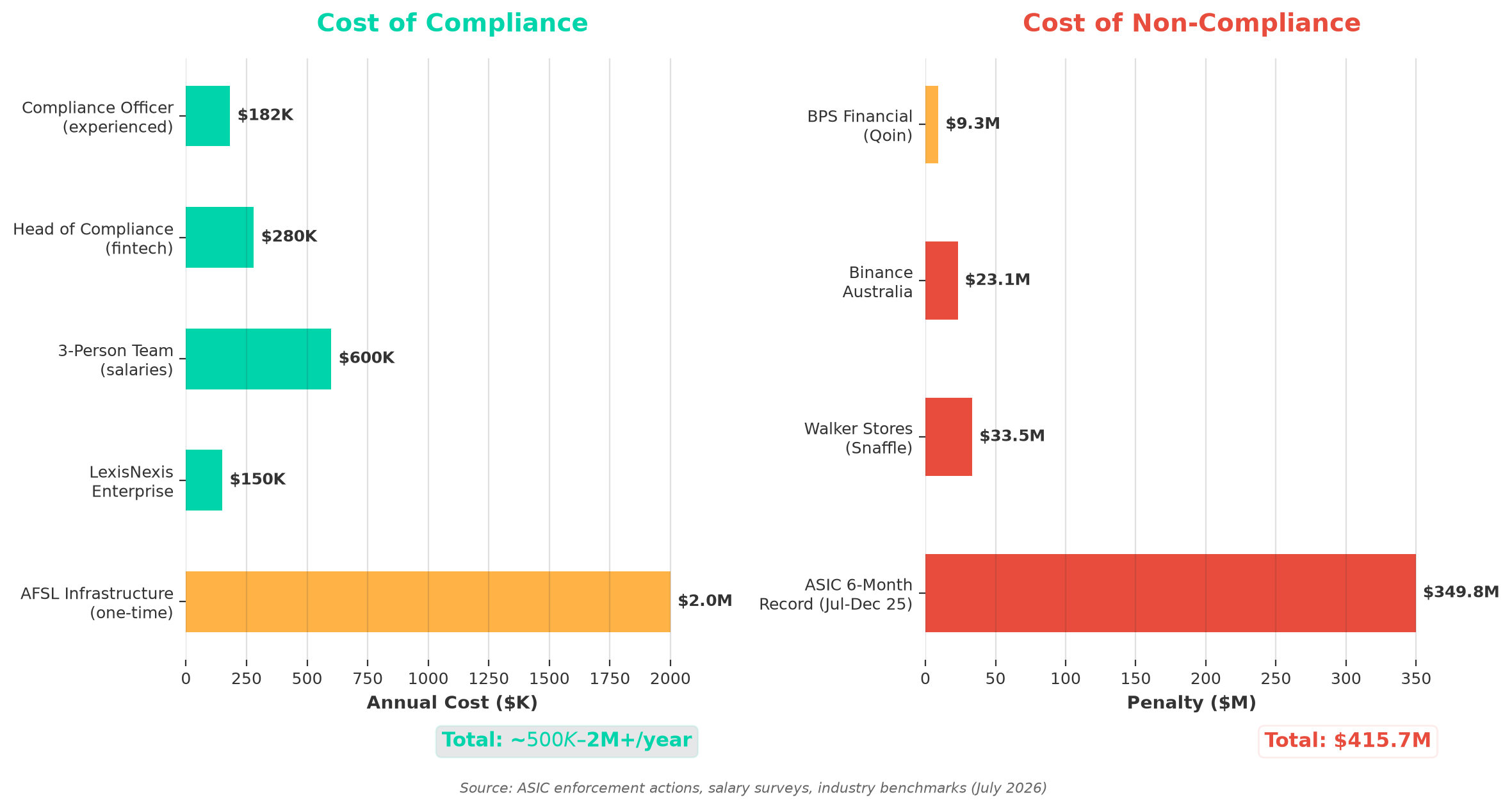
ASIC's record speaks for itself:
| Metric | Jul-Dec 2025 | Change |
|---|---|---|
| Civil penalties | $349.8 million | Six-monthly record |
| Consumer remediation | $583 million | Up 38% |
| New civil proceedings | 23 | Up 53% |
| Investigations commenced | 123 | Up 13% |
ASIC's Deputy Chair Sarah Court put it plainly: "We're doing more investigations, taking more matters to court and securing record penalties."
That's not a threat. It's a statement of fact.
The Cost of Compliance (vs the Cost of Not)
Here's where it gets interesting. The common narrative is that compliance is too expensive for crypto businesses. Let's actually compare.
The Cost of Compliance
| Item | Annual Cost |
|---|---|
| Compliance Officer (experienced) | $128K – $182K |
| Head of Compliance (fintech) | $180K – $280K |
| 3-person compliance team | $400K – $600K |
| LexisNexis enterprise plan | $80K – $150K |
| AFSL compliance infrastructure (one-time) | $500K – $2M+ |
The Cost of Non-Compliance
| Entity | What They Paid |
|---|---|
| Binance Australia | $23.1 million |
| BPS Financial (Qoin) | $9.3 million |
| Walker Stores (Snaffle) | $33.5 million |
One BPS Financial penalty covers a compliance team for 15 years.
The Gap No One Is Talking About
The Australian crypto market has an estimated 60 to 80 platforms operating. Of those, industry estimates suggest only 25 to 30 are likely to obtain the AFSL they need.
That leaves 40 to 50 platforms exposed.
The no-action letter that's been protecting them expires on 30 September 2026. That's roughly 10 weeks from now.
The DAF Act commences on 9 April 2027. That leaves a 6-month gap where platforms are operating without transitional protection and without a fully formed regulatory framework.
What Mirror AI Does Differently
Most compliance tools are backwards-looking. They tell you what the law said yesterday. Mirror AI's compliance intelligence maps live obligations across 6 jurisdictions — 5,635 AU obligations, 400 MiCA obligations, 15 regulatory topics, all queryable in real time.
For a platform facing the September deadline, that means:
- Know what you need — obligation mapping by jurisdiction, entity type, and activity
- Know what you're missing — gap analysis against your current compliance posture
- Know what it costs — real numbers, not estimates
The Bottom Line
A compliance team costs $400K to $600K a year. A LexisNexis license costs $80K to $150K. A penalty for getting it wrong costs $9 million to $23 million.
The math isn't complicated. The question is whether you do the math before or after the regulator does it for you.
About Mirror AI
Mirror AI is crypto intelligence infrastructure. We map regulatory obligations across jurisdictions, score token risk, and provide real-time compliance intelligence through our MCP database. Visit mirror.glasslane.io to learn more.